Breast Lift · With or Without Implants · Bogotá, Colombia
Breast lift in Colombia: an implant does not lift a breast
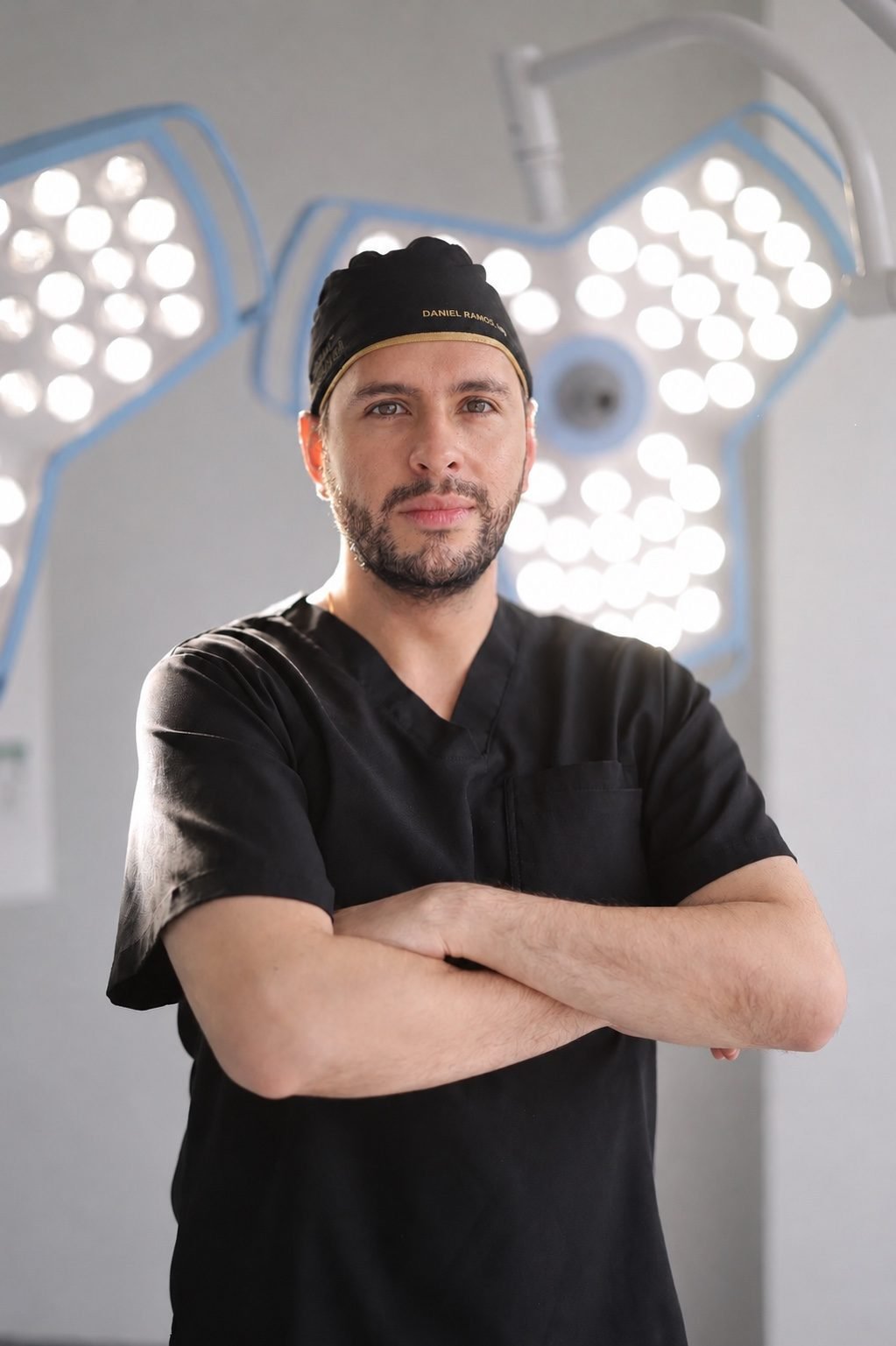
When the breast sags, what needs to move is the nipple and what is left over is skin. A lift puts them back in place; an implant, if needed, only adds the volume that was lost. Which technique fits your degree of sagging, what scar it leaves, and when adding an implant makes sense. By Dr. Daniel Ramos, SCCP board-certified plastic surgeon.
What is a breast lift? Lifting is not the same as enlarging
A sagging breast — ptosis, in medical terms — is almost always the sum of three things: skin that has stretched with pregnancy, breastfeeding, weight changes or time; breast tissue that has emptied or slid downward; and a nipple that has dropped with it, to the breast fold or below. A breast lift — mastopexy — corrects all three: it removes the excess skin, reshapes the tissue to restore projection, and raises the nipple-areola complex to its proper position. What it does not do on its own is add volume. That is what a lift with implants is for: when, besides sagging, the breast has emptied and you want the cleavage back. And that is why an implant alone cannot lift: it adds weight to a breast that has already dropped.
Adding an implant or lifting the breast
A sagging breast gets offered both. One puts it back in place. The other makes it bigger, heavier and, over time, lower.
- The implant is chosen for the volume you want, without measuring where the nipple sits relative to the fold.
- The implant fills the top, but the sagging tissue keeps hanging in front of it.
- A «double bubble» can appear: the implant's edge above and the sagging breast below.
- The added weight speeds up the very sagging it was supposed to fix.
- Nipple position, excess skin and volume are measured, and the degree of sagging is defined.
- Excess skin is removed and the tissue is reshaped to restore shape and projection.
- The nipple and areola are raised into place without detaching them from the tissue beneath.
- If volume is missing, an implant proportionate to your tissue is added — not the largest possible.
If your breasts are not sagging and you want more volume, the operation is breast augmentation, not a lift. And if pregnancy changed your abdomen as well, both can be planned together in a mommy makeover.
Which technique fits each degree of sagging
Periareolar
The nipple sits at or near the breast fold. Removing a ring of skin around the areola may be enough. A single scar, at the edge of the areola. It has a limit: forced onto greater sagging, it widens the areola and flattens the breast.
Vertical
The nipple is below the fold. The scar circles the areola and runs straight down to the fold — the «lollipop». It allows more skin to be removed and the tissue to be reshaped for projection.
Inverted T
Significant sagging with a lot of excess skin, often after major weight loss. A horizontal scar in the breast fold is added to the vertical one. It is more scar, and it is what allows a result that does not drop again within months. There is no honest shortcut.
How the technique is decided
It is not the surgeon's preference or the implant catalogue. The technique follows a classification of sagging that has been in use for half a century, and the decision to add an implant in the same operation has data behind it.
Regnault graded sagging by where the nipple sits relative to the breast fold: grade I at the fold, grade II below it, grade III at the lowest point of the breast. He also separated pseudoptosis: the breast looks low, but the nipple is still above the fold. It is the first thing measured in the consultation.
Regnault P. Clin Plast Surg. 1976;3(2):193A meta-analysis of 23 studies and 4,856 cases of lift with implant in the same operation found a complication rate of 13.1% and a reoperation rate of 10.7%. The most common complication was the breast dropping again, followed by poor-quality scars.
Khavanin N, et al. Plast Reconstr Surg. 2014;134(5):922In a series of 332 cases, reoperation was 20% in primary operations and 31% in secondary ones — patients who already had implants. Combining the two operations added no more risk than doing them separately, but it requires choosing well who gets it and with which implant.
Calobrace MB, et al. Plast Reconstr Surg. 2013;131(1):145This is not meant to discourage you: it is so you know what is being measured in your consultation, and why sometimes the right answer to «I want an implant» is a lift, or doing the two operations in two stages.

The breast as part of the torso
Dr. Daniel Ramos Hernández is board-certified by the Colombian Society of Plastic Surgery (SCCP) and trained in Plastic, Reconstructive and Aesthetic Surgery at Universidad El Bosque. His reconstructive training is a school of respect for tissue — operating with what remains in mind, not only what is removed or added — the same principle behind the MIA and Preserve tissue-preservation techniques he uses in breast surgery. And his Total Definer fellowship with Dr. Alfredo Hoyos adds something that matters when the breast is planned together with the abdomen or the waist: reading the torso as a single unit. See his full training and credentials.
Colombian Society of Plastic Surgery
Breast tissue preservation
Body contouring · Dr. Alfredo Hoyos
What we do not do in a breast lift
- We do not use an implant to «lift». If the nipple is at or below the breast fold, an implant only adds weight to a breast that has dropped. We tell you at the consultation, even if you came in asking for an augmentation.
- We do not promise a scarless lift. Raising the nipple means removing skin, and skin is removed through an incision. We draw where the scar will be, based on your degree of sagging, before surgery.
- We do not force the periareolar technique onto greater sagging. A scar only around the areola is tempting, but with moderate or severe sagging it widens the areola, flattens the breast and drops again. The technique is chosen by the degree, not by the shortest scar.
- We do not operate too soon. With recent pregnancy or breastfeeding, or in the middle of losing weight, the breast is still going to change. We wait for it to settle, and before surgery breast health is checked according to your age and history.
Breast lift recovery and what to expect
Typical ranges — your personalised surgical plan sets the exact details for your case, especially if an implant is added.
How much does a breast lift cost in Colombia?
There is no single price, because the same name covers anything from a periareolar lift for mild sagging to an inverted-T lift with an implant. What we can tell you precisely is what it depends on.
The consultation — in person or virtual — is the only point from which a responsible figure can be given, because first we need to measure where your nipple sits and how much skin is left over.
Request my personalised quoteTravelling from the US or abroad, step by step
- Virtual consultation from wherever you are. Video call with Dr. Ramos, review of front and side photos, and a first answer on your degree of sagging and whether an implant makes sense.
- A stay planned around your surgery. In-person assessment, tests, surgery and follow-ups. How many days you need in Bogotá depends mostly on whether an implant is added or another operation is combined.
- Support during your stay. Guidance on recovery accommodation, transfers and logistics.
- Follow-up for the whole first year. Virtual check-ins until the breast settles and the scars mature.
Breast lift before and after, real cases
We have not yet published a breast lift case here, and we will not show an augmentation case as if it were one: they are different operations. At the consultation we show you cases from patients who agreed to share them, and we post results regularly on Instagram.
All about breast lifts
It depends mainly on two things: how far the breast has dropped, which sets the technique and the scar, and whether the plan includes an implant. A periareolar lift for mild sagging and an anchor (inverted-T) lift with an implant are different operations in operating time, supplies and recovery. The implant brand and type also matter — Dr. Ramos works mainly with Motiva, Mentor and GC Aesthetics — as do the accredited facility, anaesthesiology, and whether it is combined with another operation, such as a tummy tuck in a mommy makeover. A personalised, all-inclusive quote comes after the consultation, which can be virtual.
Yes, and for many patients it is the best option. A lift on its own removes the excess skin, reshapes the breast tissue and raises the nipple and areola to where they belong. What it does not do is add volume: if the breast emptied out after pregnancy or weight loss, without an implant it will be lifted but the same size, and the upper pole — the cleavage — may still look flat. If that matters to you, adding an implant is assessed; if you only want the breast back in its place, you do not need one.
No. When the nipple is already at or below the breast fold, an implant only adds weight to a breast that has dropped: the top fills out and the tissue keeps hanging in front of it, sometimes with a «double bubble» look. An implant can disguise very mild sagging or pseudoptosis, but true sagging is corrected by moving the nipple and removing skin. That is why the consultation question is not which implant you want, but where your nipple sits relative to the fold.
It depends on the degree of sagging. For mild sagging, a scar around the areola may be enough. For moderate sagging, the scar usually circles the areola and runs vertically down to the fold — the «lollipop». For significant sagging, a horizontal scar in the breast fold is added: the anchor or inverted-T pattern. There is no real lift without a scar, and the more excess skin there is, the more scar it takes to remove it. It is drawn with you before surgery, and it matures — flattens and fades — over the first year.
Both options exist. One stage avoids a second operation, but it is more demanding because the breast is enlarged and the skin is reduced at the same time. A meta-analysis of almost five thousand cases found a complication rate of about 13% and a reoperation rate close to 11%, with recurrent sagging as the most common complication. When sagging is severe, the tissue is thin or a large implant is wanted, separating the two operations is sometimes safer. It is decided in the consultation, with measurements in hand.
A lift repositions the breast, but it does not stop ageing, gravity or weight changes. Over the years the breast descends to some degree again, and a pregnancy or a large weight change can speed that up. A large implant also accelerates recurrence because it adds weight. What helps the result last is having surgery at a stable weight, with no near-term pregnancy plans, and with an implant — if any — proportionate to your tissue.
In many cases yes, because the usual techniques keep the areola attached to the breast tissue beneath it. But nobody can guarantee it: breastfeeding also depends on each woman, and any breast surgery can affect it. That is why the usual advice is to wait until you have finished having children and breastfeeding — with a margin of several months for the breast to settle — before surgery. If you plan more children, it is worth discussing at the consultation.
Most patients return to desk work in about a week. The post-surgical bra, without underwire, is worn day and night for several weeks, and arm exertion and upper-body exercise wait longer than everything else. It is normal for the breasts to feel tight, swollen and to have changes in nipple sensation for weeks. The shape settles over the first months and the scars finish maturing around the one-year mark. Your surgical plan sets the exact timing, especially if an implant is added.
Let's talk about your case
Tell us what you would like to change, whether you have had pregnancies or weight changes, and whether you are considering an implant, and we will reply with an honest, personalised plan. Consultations in Bogotá and virtual, in English and Spanish.