
Gynecomastia · Male Chest · Bogotá, Colombia
Gynecomastia surgery in Colombia: a cannula cannot cut gland
Glandular tissue is firm and fibrous, which is why a chest treated with liposuction alone keeps the same lump under the nipple. Excision of the gland and liposuction of the fatty component, in one operation. By Dr. Daniel Ramos, SCCP board-certified plastic surgeon.
What gynecomastia surgery actually is: two tissues, two techniques
An enlarged male chest is almost never one single thing. There is a disc of gland, firm and well defined, sitting directly beneath the nipple; and there is fat, soft and spread across the chest, the lateral border and the axilla. They are different tissues and they come out in different ways: the gland is excised with a blade through an incision hidden at the edge of the areola, the fat is aspirated with fine cannulas. Doing only one of the two explains most of the results that fail to convince. And there is one rule that decides how the chest looks at three months: a layer of tissue is always preserved beneath the areola. Emptying that area completely leaves the nipple sunk against the muscle — the crater deformity — and that is harder to fix than the gynecomastia you arrived with.

Suctioning the chest or removing the gland
Both get quoted as "gynecomastia surgery". One leaves the chest flat. The other leaves the same hard lump, now without the fat that was hiding it.
- The chest is treated as if it were all fat, with no one palpating the glandular disc before booking.
- The cannula thins the edges but does not cut the fibrous retroareolar tissue: the central lump stays.
- With the surrounding fat gone, the disc stands out under the nipple more than it did before surgery.
- The cause is never investigated, so whatever produced the gynecomastia keeps working.
- The retroareolar disc is palpated and measured, the grade is defined and the technique decided before theatre.
- The gland is excised through the lower border of the areola and sent for histopathology.
- The fatty component of the chest, the lateral border and the axilla is aspirated in the same operation.
- Tissue is preserved beneath the areola and the transition into the pectoral is blended: a male chest, not a flat one.
Before any of this comes the question that decides the surgery: gland or fat? The pinch test, the four grades and the warning signs are explained in how to tell if you have gynecomastia. If what you have is only fat, the right answer is liposuction, not this operation.
What is done at each grade
Grades I and IIa
Small to moderate enlargement with no skin excess. Excision of the glandular disc through a periareolar incision plus liposuction of the fatty component. One scar, hidden at the edge of the areola.
Grade IIb
Moderate enlargement with mild skin excess. Same approach, with wider liposuction of the chest and axilla to encourage skin retraction. Postoperative compression matters more here than anywhere.
Grade III
Marked enlargement with skin excess and a descended areola. Requires skin resection and repositioning of the nipple-areola complex: more scarring, planned and drawn with you before surgery. There is no honest shortcut.
What decides the technique
It is not a surgeon's preference. The choice between aspirating, excising or resecting skin follows a classification published half a century ago and still in use, and a set of indication rules that exist so that nobody operates on something that does not need an operation.
Simon described grades I, IIa, IIb and III according to volume and, above all, according to whether skin excess is present. That is what determines whether an incision at the border of the areola is enough or whether skin also has to be resected and the nipple repositioned. Fifty years on, it is still the language this surgery is planned in.
Simon BE, Hoffman S, Kahn S. Plast Reconstr Surg. 1973;51:48Rohrich and colleagues proposed grading treatment according to tissue consistency — glandular or fibrous — and the degree of ptosis, and defined the role of ultrasound-assisted liposuction, which emulsifies fat while leaving denser structures relatively intact. Direct excision is reserved for the fibrous retroareolar tissue and for skin excess.
Rohrich RJ, Ha RJ, Kenkel JM, Adams WP Jr. Plast Reconstr Surg. 2003;111:909The American Society of Plastic Surgeons practice parameter is explicit: surgery is considered in grades II and III and after systemic causes have been ruled out. If the gynecomastia is caused by a medication or an endocrine disorder, that is treated first. And in adolescents a wait of at least a year is recommended, because most cases resolve on their own.
ASPS, Practice Parameter for GynecomastiaNone of this is meant to discourage you: it is so you know what is being looked at in the consultation, and why sometimes the right answer to "I want my chest operated on" is to wait, to change a medication or to do a different operation.

Male contouring as a specialty
Dr. Daniel Ramos Hernández is certified by the Colombian Society of Plastic Surgery (SCCP) and trained in Plastic, Reconstructive and Aesthetic Surgery at Universidad El Bosque. He completed the Total Definer fellowship with Dr. Alfredo Hoyos and in 2025 taught the male high-definition liposuction marking workshop at the SCCP National Congress. That matters here for a specific reason: gynecomastia surgery does not end when the gland comes out, but when the chest reads as a male chest again — with the transition into the pectoral blended and no step at the border — and that is contouring work. See his full training and credentials.
Colombian Society of Plastic Surgery
Male contouring · Dr. Alfredo Hoyos
Male marking workshop
What we do not do in gynecomastia surgery
- We do not operate without asking why it appeared. Medications, supplements, anabolic steroids, alcohol, sudden onset or one-sided pain: all of it is reviewed first. If it needs investigating or an endocrinology referral, that happens before surgery, not after the result.
- We do not excise all the gland beneath the areola. A layer of tissue is deliberately preserved. Emptying that area leaves the nipple sunk against the muscle — the crater deformity — which is considerably harder to correct than the original lump.
- We do not sell liposuction alone as the answer. If there is a glandular disc, a cannula will not remove it. We tell you which technique your case needs even when that means a bigger and more expensive operation than the one you came looking for.
- We do not promise a minimal scar in a grade III. When there is significant skin excess, skin has to come out. We draw where the scar will sit before surgery, so that you decide with the full picture.
Gynecomastia recovery and what to expect
Typical ranges — your personalised surgical plan defines the exact detail for your case.
Want the full week-by-week calendar? It is laid out in lipo 360 recovery, week by week, which applies equally to the liposuction component of this surgery.
What does gynecomastia surgery cost in Colombia?
There is no single price, because the same name covers everything from a small glandular excision with chest liposuction to an operation with skin resection and repositioning of the areola. What we can tell you precisely is what it depends on.
The consultation — in person or virtual — is the only point from which a responsible figure can be given, because the plan depends on how much of yours is gland and how much is fat.
Request my personalised quoteTravelling to Bogotá, step by step
- Virtual consultation from wherever you are. Video consultation with Dr. Ramos, reviewing front, profile and arms-raised photographs, with a quote.
- 7–10 days in Bogotá. In-person assessment, laboratory work, surgery, follow-up visits and a review before you fly home.
- Support during your stay. Guidance on recovery accommodation, transfers and logistics.
- Follow-up through the whole first year. Virtual check-ins until the contour has fully settled.
Gynecomastia before and after, a real result
A real case of gynecomastia correction with glandular excision and male definition, operated by Dr. Daniel Ramos in Bogotá.
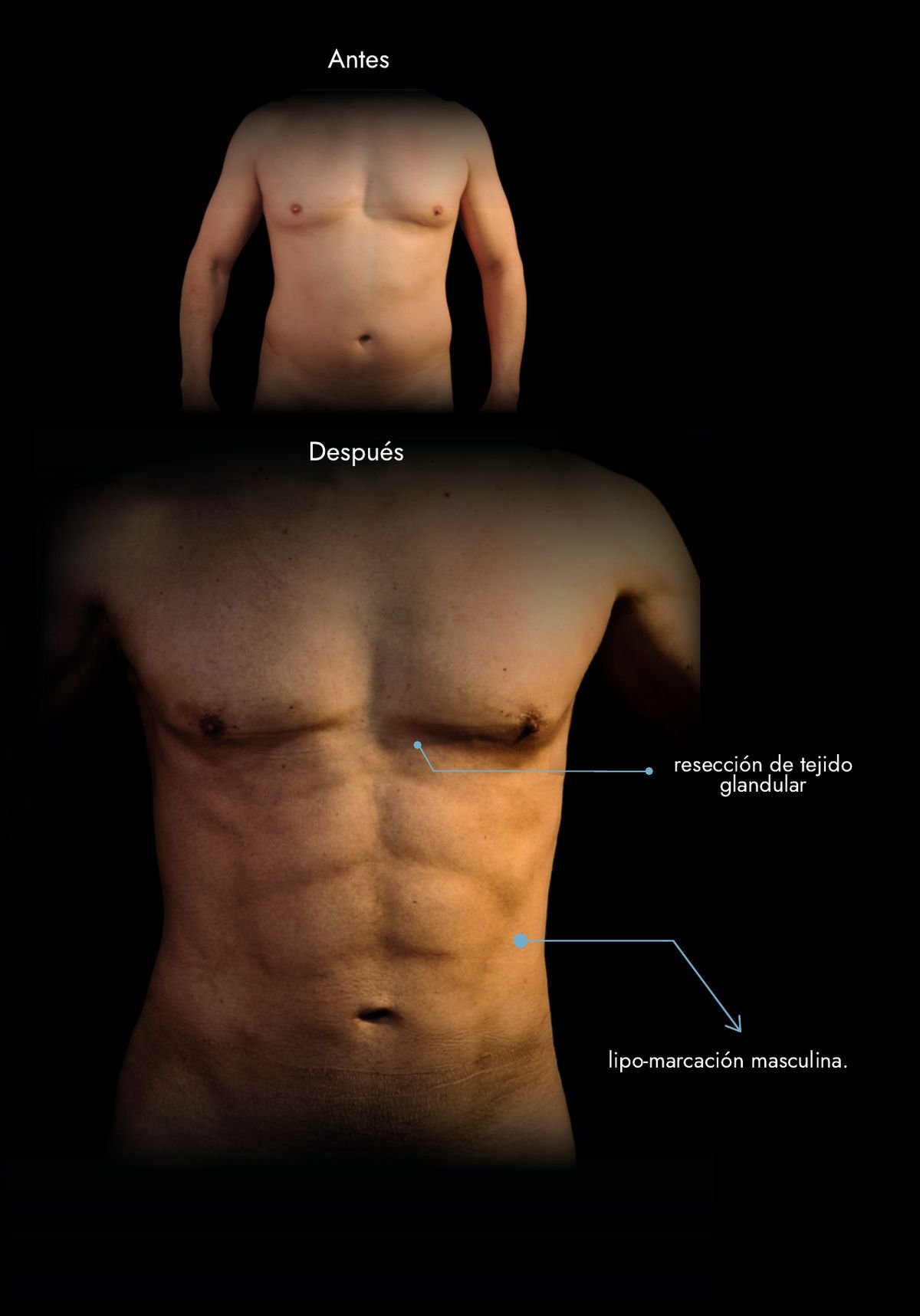
Every patient is different. The result depends on the grade of gynecomastia, the proportion of gland to fat, skin elasticity and the recovery process.
Everything about gynecomastia surgery
It depends above all on the grade. A grade I or IIa case — a glandular disc with little fatty component and no skin excess — is resolved with periareolar excision plus chest liposuction in a short operation, and is the least expensive version. A grade III case, where skin excess forces skin resection and repositioning of the areola, is a different operation: longer, more complex and with a different recovery. The type of anaesthesia matters, and so does whether it is combined with male Lipo 360 in the same session. Dr. Ramos gives you a personalised all-inclusive quote after the consultation: surgeon's fee, accredited surgical facility, anaesthesiology, supplies, compression vest, pathology of the excised tissue and follow-up through the first year. A fixed figure quoted over WhatsApp, without anyone having examined your chest, means nothing.
No, and this is the single most common reason results disappoint. Liposuction removes fat; true gynecomastia is glandular tissue — a firm, fibrous disc sitting under the nipple that a cannula will not cut or aspirate. A chest treated with liposuction alone ends up flatter at the edges with the same hard lump in the centre, sometimes more visible than before, because the fat that was camouflaging it has been taken away. The correct operation almost always combines both: excision of the gland through the border of the areola and liposuction of the fatty component of the chest, the lateral chest and the axilla. If what you have is only fat, that is pseudogynecomastia and liposuction alone does treat it. Which of the two you have is decided by palpation, and it is explained in how to tell if you have gynecomastia.
Most patients return to desk work between day five and day seven. The compression vest is worn continuously for four to six weeks: it is not optional, it is what controls swelling and helps the skin adapt to the new contour. Lower-body training usually resumes at two to three weeks, but chest, shoulders and back wait four to six weeks, because moving the pectoral muscle under a freshly operated area encourages seroma and separation of the tissue planes. The chest feels firm, numb and unevenly swollen for weeks: that is part of the process. The definitive contour appears between three and six months, once the deep swelling has resolved.
In most cases, a single semicircular scar along the lower border of the areola, on the boundary between pigmented skin and chest skin, where the change in colour hides it well. Added to that are one or two incisions a few millimetres long for the liposuction cannulas, in the lateral fold or the axilla. When there is significant skin excess — grade III — there is no honest way to promise a single small scar: those cases require skin resection, and that leaves a larger scar which is planned with you before surgery. We would rather tell you in the consultation than afterwards.
The glandular tissue that is excised does not grow back, so gynecomastia as such does not return. What can happen is that chest volume becomes visible again by one of two routes: weight gain, because the remaining fat cells enlarge; or because the cause that produced it is still active — anabolic steroids, certain medications, an untreated hormonal disorder. That is why the consultation includes reviewing what you are taking and, where the history suggests it, investigating before operating. Operating without addressing the cause is signing up for a recurrence.
Not always, but ruling out causes before taking you to theatre is not optional. The assessment starts with the clinical history: age of onset, how fast it grew, pain, symmetry, medications, supplements, anabolic steroids, alcohol and family history. If anything in that account suggests a hormonal or drug-related cause, a workup is requested and, where appropriate, you are referred to endocrinology before surgery; if the cause is a medication, the first step is to review it with whoever prescribed it. And in the presence of an atypical finding — a hard, fixed mass, nipple retraction, discharge or lymph nodes — imaging is ordered. Operating on gynecomastia without asking why it appeared is skipping half the job.
An isolated gynecomastia correction usually takes between sixty and a hundred and twenty minutes and is performed in an accredited surgical facility with a board-certified anaesthesiologist, typically under general anaesthesia or deep sedation with local anaesthesia depending on the case, with discharge the same day. When it is combined with male Lipo 360 or with liposuction of several areas, operative time and the anaesthetic plan change and are defined in the surgical plan. What decides this is not the price, nor the convenience of your calendar: it is the safety of your case.
This is a low-risk operation when performed by a board-certified plastic surgeon in an accredited facility, but it has complications worth knowing. Haematoma is the most frequent in the first hours and sometimes requires going back to theatre to drain it; seroma, asymmetry, changes in nipple sensation — almost always temporary — and scars that widen can also occur. The crater or saucer deformity is the one behind your question: it happens when all the gland beneath the areola is excised and the nipple ends up sunken against the muscle, with a ring of tissue around it. It is a difficult result to correct, and that is why a layer of tissue is always preserved beneath the nipple-areola complex. Emptying that area completely looks good on the operating table and bad at three months.
Let's talk about your case
Tell us how long you have noticed it and what you have tried, and we will reply with an honest, personalised plan. Consultations in Bogotá and virtual, in English and Spanish.